







Beginner's Guide to World of Warcraft: Starting Your Adventure in Azeroth
Introduction
Welcome to World of Warcraft, the long‑standing MMORPG that invites players to explore a vast fantasy world filled with quests, battles, and stories. This guide is aimed at those who are new to the game or returning after a break, offering a clear path from the first steps to the endgame. We will cover choosing a realm, creating a character, learning the interface, mastering core mechanics, and finding enjoyable activities that suit your playstyle. By the end of this guide you should feel comfortable stepping into Azeroth and setting your own goals.
Choosing Your Realm and Faction
Check which version of World of Warcraft you are playing before choosing a realm. Modern WoW (Retail) and WoW Classic use different realm rules. In Retail, Blizzard describes Normal and Role-Play (RP) realm types, with War Mode offering opt-in outdoor PvP. Choosing a modern realm does not permanently lock you into a traditional PvP or PvE world. Classic editions can include distinct PvP, Normal or Hardcore rulesets depending on the version, so read that edition’s current realm information before creating a character.
Select a region and community where you can play with friends and communicate comfortably. Alliance and Horde provide different character options and stories; do not assume that one faction is inherently better for every player or every version.
| Decision | Practical question |
|---|---|
| Retail or Classic | Which set of game rules and progression do you intend to use? |
| Realm/community | Where do your friends play, and what language or playstyle suits you? |
| Faction and race | Which available character and story options appeal to you? |
| PvP rules | Are you choosing an opt-in Retail War Mode experience or a Classic realm ruleset? |
For version and subscription differences, see WoW subscription and editions explained and Blizzard’s new-player reference.
Creating Your Character
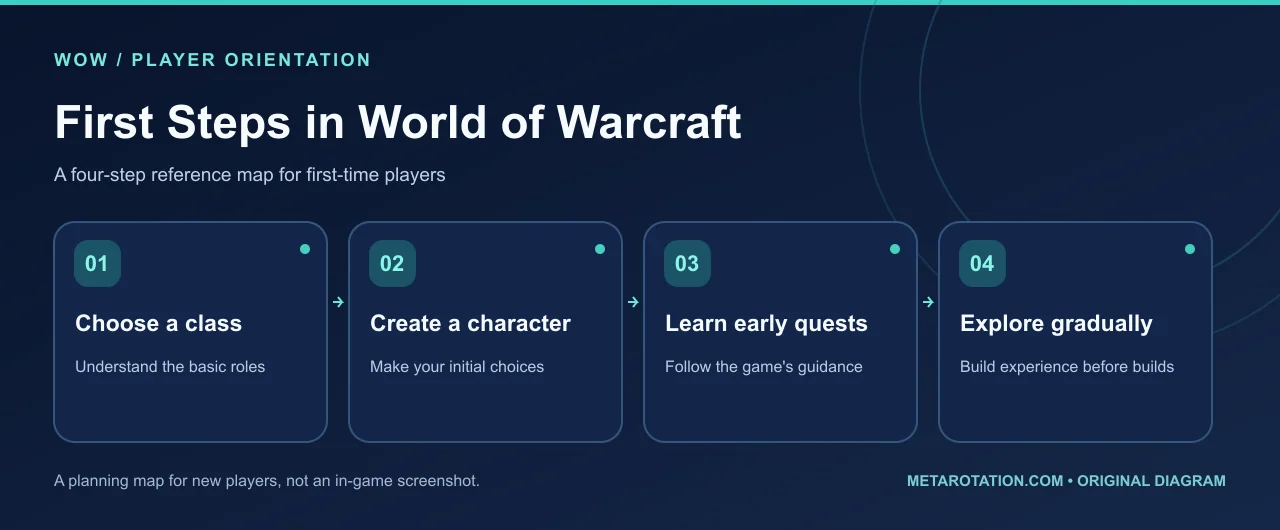
After selecting a realm and faction you will move to the character creation screen. Here you choose a race, a class, and customize appearance. Race influences your character identity and racial abilities; starting experiences can differ between modern WoW and Classic editions, so follow the options shown by the version you are playing. Class defines your role in combat and the abilities you will learn as you level. The game offers a variety of classes that fall into three broad categories: damage dealers, healers, and tanks.
When picking a class think about what you enjoy doing in other games. If you like being at the forefront of battle, absorbing hits and protecting allies, a tank class might suit you. If you prefer supporting teammates with healing spells and buffs, a healer class could be a good fit. If you enjoy dealing damage from a distance or up close, a damage dealer class will let you focus on offense. You can always try a different class later by creating a new character.
Appearance options include facial features, hairstyles, skin tones, and accessories. Take your time to make a look that you will enjoy seeing on screen for many hours.
Understanding the User Interface
The user interface (UI) in World of Warcraft is designed to give you quick access to important information while keeping the screen clear for the action. The main elements include the action bar, minimap, chat frame, and unit frames. The action bar holds your abilities and items; you can drag skills onto it and use keybinds to activate them. The minimap shows your current location, nearby points of interest, and party members. The chat frame lets you communicate with other players through text, voice, or emotes. Unit frames display health, mana, and other resources for yourself, your target, and your group.
You can customize the UI by unlocking the lock button, moving frames, and resizing them. Many players also use addons to add extra functionality, but the default UI is sufficient for learning the basics. Take a few minutes to explore each part, hover over icons to see tooltips, and practice opening your spellbook and character sheet.
Core Gameplay Mechanics
At its heart World of Warcraft revolves around gaining experience, completing quests, and improving your character’s power. Experience points (XP) are earned by defeating enemies, finishing quests, and discovering new locations. As you accumulate XP you level up, which grants new abilities, increases your stats, and unlocks access to higher‑level content.
Stats such as strength, agility, and intellect influence how effective your abilities are. The effect of primary and secondary attributes depends on your class and specialization; do not assume that a single stat formula applies to every character or game edition. The exact impact varies by class, but the principle is that higher stats make you stronger in your chosen role.
Combat uses a target‑based system. You select an enemy or ally, then press buttons on your action bar to use abilities. Some abilities have cooldowns, meaning you must wait a short time before using them again. Managing cooldowns and positioning yourself correctly are key skills to develop as you play.
Questing and Leveling
Quests are the primary way to gain experience and learn the story of each zone. They appear as exclamation marks over NPCs’ heads or as icons on your minimap. When you accept a quest you receive a description of the objective, which might involve collecting items, defeating a certain number of foes, or talking to another character. Completing a quest rewards you with XP, gold, items, and sometimes reputation with a faction.
While leveling you will travel through a series of zones that are designed for specific level ranges. Early zones introduce basic mechanics, while later zones present tougher enemies and more complex quest lines. It is advisable to follow the quest flow provided by the game, but you are free to explore off the beaten path if you discover interesting locations or rare enemies.
Group quests exist for players who want to team up. These are marked with a group icon and often require two or more players to complete. Joining a group can make challenging quests easier and provide a social experience.
Exploring Zones and Regions
Azeroth is divided into continents, each containing multiple zones with distinct environments, lore, and challenges. From the lush forests of Elwynn to the arid deserts of Tanaris, each zone offers a unique visual style and set of creatures. As you move through the world you will encounter points of interest such as dungeons, raid entrances, and PvP battlegrounds.
Exploration rewards include discovering hidden treasures, completing achievements, and unlocking flight paths that let you travel faster between locations. Take time to enjoy the scenery, read the lore books scattered around, and talk to NPCs who may offer side stories or optional tasks.
Dungeons and Group Content
Dungeons are instanced areas designed for small groups of players, usually five. They feature a series of encounters that culminate in a boss fight. Dungeons provide better gear, more experience, and unique story moments compared to open‑world questing. To enter a dungeon you typically use the dungeon finder tool, which matches you with other players looking for the same activity.
Inside a dungeon you will need to fulfill a role: tank draws enemy attention, healer keeps the group alive, and damage dealers focus on defeating foes. Communication is important; using voice chat or the built‑in chat helps coordinate strategies. Each dungeon has a difficulty level, and as you progress you can attempt harder versions for better rewards.
Raids are larger scale versions of dungeons, intended for groups of ten or more players. They require more coordination and often have complex mechanics. While raids are a major endgame activity, many players enjoy them as a social challenge.
Professions and Crafting
Professions let you gather resources and create items that can enhance your character or be sold to other players. There are gathering professions, such as mining and herbalism, which collect raw materials from the world, and crafting professions, such as blacksmithing and tailoring, which turn those materials into gear, consumables, or other useful items. Below is a simple overview of common profession pairs.
| Profession Type | Examples | Typical Output |
|---|---|---|
| Gathering | Mining, Herbalism, Skinning | Ore, herbs, leather |
| Crafting | Blacksmithing, Leatherworking, Tailoring | Armor, weapons, cloth goods |
| Service | Enchanting, Inscription, Jewelcrafting | Buffs, glyphs, gems |
You can learn two primary professions at a time, and you may also take up secondary professions like cooking or fishing for additional benefits. Professions give you a way to make money, customize your gear, and contribute to your guild’s economy.
Player versus Player (PvP) Basics
If you enjoy testing your skills against other players, World of Warcraft offers several PvP options. Battlegrounds are large, objective‑based maps where teams compete to capture flags, control bases, or achieve other goals. Arenas are smaller, team‑focused fights that emphasize quick reflexes and precise coordination. In modern WoW, War Mode provides an opt-in route to open-world PvP. Some Classic editions use different realm PvP rules, so consult the edition you are playing.
Participating in PvP earns you honor points, which can be spent on special gear and rewards. It also contributes to your character’s PvP ranking. New players are encouraged to start with battlegrounds to learn the basics before moving to more intense arena matches.
Social Features and Guilds
The game’s social systems are designed to help you connect with others. You can add friends, join chat channels, and create or join a guild. A guild is a player‑run community that offers shared storage, a guild chat, and often organizes events such as dungeon runs, raids, or social gatherings. Being part of a guild can make it easier to find groups, learn encounters and participate in community activities; specific perks vary by version.
Guilds often have their own rules and expectations, so it is worth reading the guild description before applying. Many guilds recruit players of all experience levels, and some focus on casual play while others aim for high‑level progression.
Endgame Overview
Once you reach the maximum level, the focus shifts from leveling up to acquiring better gear, completing challenging content, and pursuing personal goals. Endgame activities include heroic dungeons, mythic raids, rated battlegrounds, and arena seasons. There are also collection goals such as earning achievements, obtaining rare mounts, and completing reputation grinds with various factions.
Players often set their own objectives, whether it is to master a particular class, to become a top PvP competitor, or to explore every corner of the world. The game regularly introduces new content updates that add fresh zones, storylines, and mechanics, ensuring that there is always something new to experience.
Tips for New Players
Here are some practical suggestions to help you get started smoothly:
- Take your time with the tutorial and early quests; they teach essential mechanics that will be useful later.
- Experiment with different classes by creating low‑level characters to see which playstyle feels most natural.
- Join a beginner‑friendly guild or community where you can ask questions and receive guidance.
- Use the dungeon finder tool early to experience group play and learn role responsibilities.
- Keep an eye on your inventory; sell or deposit items you do not need to avoid encumbrance.
- Explore the world at your own pace; there is no rush to reach max level.
- Remember that dying is part of learning; each defeat can teach you something about your abilities or positioning.
- Enjoy the story and the world; the game’s richness lies in its lore as much as its combat.
Sources
This guide is based on original analysis and general knowledge of World of Warcraft. No external sources were copied or fabricated.
Sources
- Blizzard: New Players Starter Guide — Retail onboarding, realm types and class choices.
- Blizzard: WoW Classic — Edition-specific Classic information.
Share Article
If this article helped you, please share it with others!