


Digital Foundry Breaks Down Monster Hunter Wilds Switch 2 Demo Performance
What changed
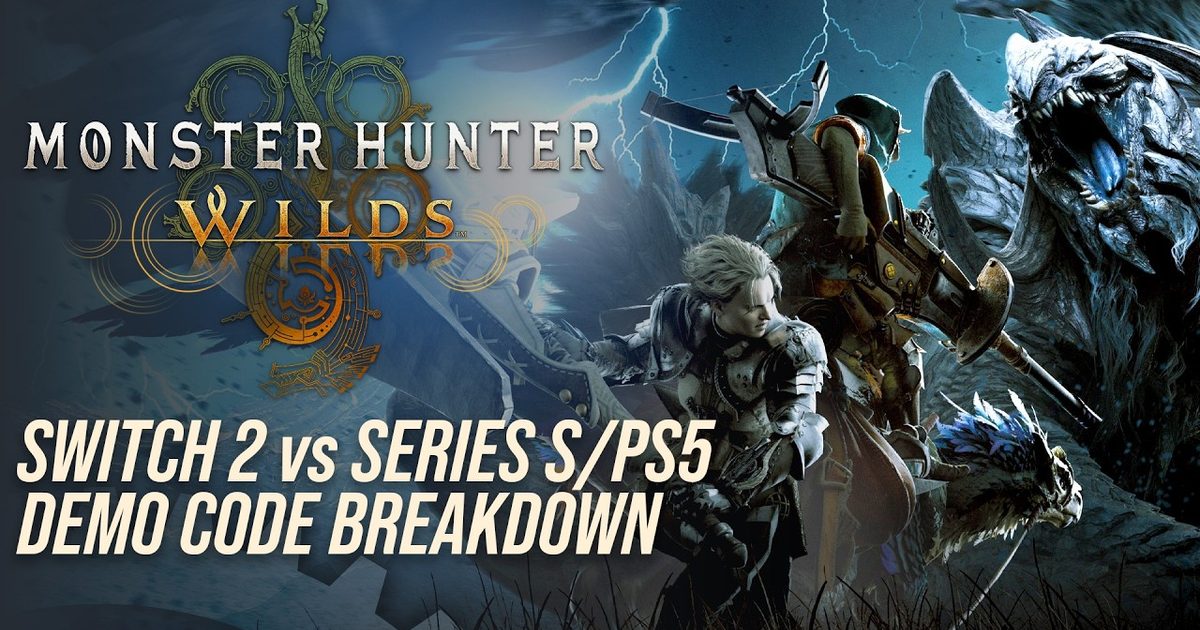
Digital Foundry recently evaluated the technical performance of the Monster Hunter Wilds demo running on the Nintendo Switch 2. In the default quality preset, the game maintains a steady 30 frames per second, with only brief, minor dips during cinematic sequences. Frame pacing remains highly consistent throughout standard gameplay. Players can also activate a performance preset that pushes the framerate into the 40 to 55 FPS range, though this requires dropping the internal resolution slightly and turning off screen-space reflections. Tests were also conducted at a 120 Hz output, but variable refresh rate support did not function as anticipated.
Internally, the Switch 2 build operates at approximately 648p in quality mode, a step below the roughly 1080p baseline seen on Xbox Series S. Capcom offsets this gap using NVIDIA DLSS reconstruction, which delivers a noticeably cleaner image across various environments. Surprisingly, the Nintendo version occasionally utilizes higher-resolution texture assets than its Xbox counterpart, particularly on books, character apparel, and environmental surfaces. It also includes screen-space reflections that the Xbox port completely omits. To balance these enhancements, the Switch 2 edition implements several visual reductions: shadows carry less detail, certain object geometries are simplified, and animations for distant foliage and background characters are heavily restricted. When played in handheld mode, the internal resolution falls to about 432p, resulting in a softer picture compared to docked play, though the 30 FPS cap remains intact.
Meanwhile, the PlayStation 5 iteration boasts sharper geometry and superior texture fidelity, though testers identified noticeable aliasing artifacts caused by its reliance on FSR 1 upscaling.
Why it matters
Capcom successfully navigated significant hardware constraints to deliver a visually respectable port. By strategically deploying DLSS and selectively upgrading specific texture maps, the developers achieve a competitive image quality despite a lower native render resolution. The trade-offs, such as trimmed shadow complexity and animation culling, highlight the practical reality of porting a graphically intensive action RPG to newer hybrid hardware. Furthermore, the confirmed inclusion of full online cross-play and wireless local co-op ensures that the Switch 2 audience will not miss out on core multiplayer functionality, bridging the gap between portable and traditional gaming experiences.
What to do next
The original launch for Monster Hunter Wilds occurred on February 28, 2025, across PlayStation 5, Xbox Series X/S, and PC. The Nintendo Switch 2 version is officially scheduled to arrive on December 4, 2026. Once released, players can expect unified online matchmaking across all platforms and the ability to team up locally via wireless connections. Current-gen console owners may want to monitor future patches, particularly if Capcom addresses the FSR 1 jaggedness observed on PlayStation 5. For now, the technical data provides a clear roadmap of what to expect when the port finally arrives.
Share Article
If this article helped you, please share it with others!